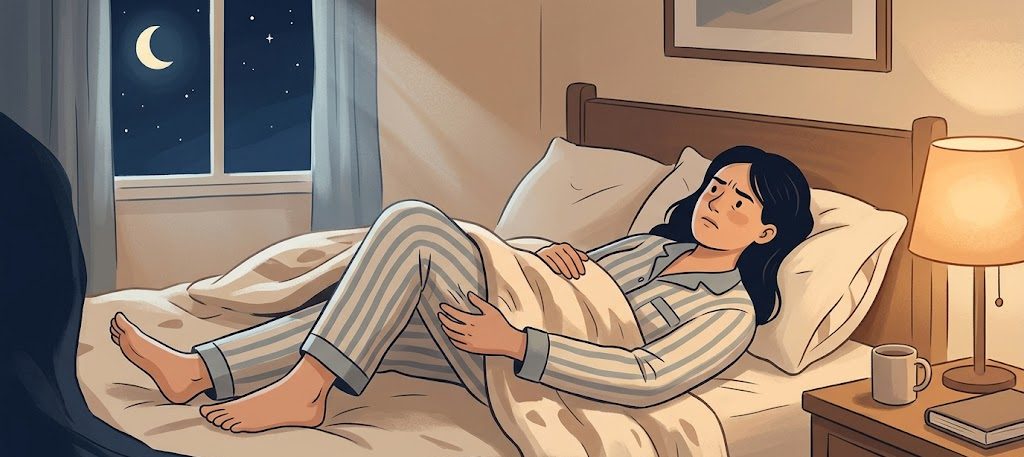
What Is Restless Legs Syndrome?
Restless legs syndrome (RLS), also known as Willis-Ekbom disease, is a neurological sensory-motor disorder characterized by an uncomfortable urge to move the legs that typically worsens during rest and in the evening. It is one of the most common sleep-related movement disorders, affecting an estimated 5-10% of adults, with women affected roughly twice as often as men.
RLS can range from a mild annoyance to a severely debilitating condition that significantly disrupts sleep, daytime functioning, and quality of life. Despite being common, it is frequently underdiagnosed or misdiagnosed.
What Does RLS Feel Like?
People with RLS describe the sensations in different ways, but common descriptions include:
- An irresistible urge to move the legs
- Crawling, creeping, or tingling sensations deep inside the legs
- Pulling, throbbing, or aching feelings
- A sense of "electricity" or buzzing in the legs
- An internal restlessness that is difficult to describe
- Itching deep under the skin that can't be scratched
The sensations are not the same as muscle cramps, numbness, or the "pins and needles" of a limb falling asleep. Most patients describe them as deeply uncomfortable rather than painful, though some people do experience pain.
While the legs are most commonly affected, RLS can also involve the arms, torso, or even phantom limbs in amputees.
The Five Diagnostic Criteria
The International Restless Legs Syndrome Study Group (IRLSSG) established five essential criteria that must all be present for a diagnosis of RLS:
1. An urge to move the legs
The urge is usually, but not always, accompanied by uncomfortable sensations in the legs. In some cases, the urge to move exists without any associated discomfort, and occasionally the arms or other body parts are involved.
2. Symptoms begin or worsen during rest or inactivity
Lying down, sitting, or any prolonged period of inactivity triggers or worsens symptoms. This distinguishes RLS from conditions that cause leg discomfort during activity.
3. Symptoms are partially or totally relieved by movement
Walking, stretching, bending, or rubbing the legs provides at least temporary relief. The relief persists as long as the movement continues.
4. Symptoms occur exclusively or predominantly in the evening or night
While severe RLS can cause daytime symptoms, the hallmark of RLS is that symptoms are worst in the evening and at bedtime. For many patients, symptoms begin within minutes of getting into bed.
5. Symptoms are not solely explained by another condition
The symptoms cannot be better accounted for by another medical or behavioral condition such as leg cramps, positional discomfort, leg edema, arthritis, or habitual foot tapping.
What Causes RLS?
Primary (Idiopathic) RLS
The majority of RLS cases have no identifiable underlying cause. Research points to two key mechanisms:
Dopamine dysfunction: The brain uses dopamine to regulate movement. In RLS, dopamine signaling appears to be disrupted, particularly in the evening when dopamine levels naturally decline. This may explain why symptoms follow a circadian pattern.
Iron deficiency in the brain: Iron is essential for dopamine production. Research consistently shows that people with RLS have lower iron levels in specific brain regions, even when their blood iron levels appear normal. This is why checking ferritin levels is critical — brain iron can be low even with "normal" blood tests. For a deeper look at this connection, see The Role of Iron in Restless Legs Syndrome.
Genetics: RLS has a strong genetic component. More than 60% of people with RLS have a family member with the condition. Several gene variants have been identified that increase susceptibility.
Secondary RLS
RLS can also be caused or worsened by other conditions:
- Iron deficiency: The most important treatable cause. Low ferritin (even within the "normal" range below 75 mcg/L) is strongly associated with RLS
- Pregnancy: Affects up to 25-30% of pregnant women, particularly in the third trimester. Usually resolves after delivery
- Kidney disease: End-stage renal disease significantly increases RLS risk
- Peripheral neuropathy: Nerve damage in the legs can trigger or mimic RLS
- Medications that worsen RLS: Certain antidepressants (SSRIs, SNRIs), anti-nausea drugs (metoclopramide, prochlorperazine), antihistamines (diphenhydramine), and some antipsychotics
- Magnesium deficiency: May contribute to RLS symptoms in some patients
Periodic Limb Movements of Sleep (PLMS)
Approximately 80-90% of people with RLS also have periodic limb movements of sleep (PLMS) — involuntary, repetitive leg jerks or twitches that occur during sleep. These movements typically involve extension of the big toe and flexion of the ankle, knee, or hip, happening in regular intervals of 20-40 seconds.
PLMS can occur independently without RLS. They are measured during a sleep study and quantified as the PLMI (Periodic Limb Movement Index) — the number of movements per hour of sleep.
Not all PLMS disrupt sleep. Many occur without arousal. However, when PLMS cause frequent awakenings and daytime symptoms, the condition is classified as Periodic Limb Movement Disorder (PLMD).
How Is RLS Diagnosed?
RLS is primarily a clinical diagnosis — there is no single blood test or imaging study that confirms it. Diagnosis is based on:
Clinical history
Your doctor will ask detailed questions about your symptoms, when they occur, what makes them better or worse, family history, and the impact on your sleep and daily life.
Iron studies
The 2025 AASM guidelines emphasize that all patients with clinically significant RLS should have serum iron studies checked, including:
- Serum ferritin: The most important test. A ferritin level below 75 mcg/L may contribute to RLS, even though standard lab reference ranges consider levels above 12-30 mcg/L as "normal"
- Transferrin saturation (TSAT): Should be above 20%
- Serum iron and total iron binding capacity (TIBC)
Sleep study (polysomnography)
Not required for diagnosis in most cases, but may be recommended to:
- Assess for PLMS
- Rule out other sleep disorders (e.g., sleep apnea)
- Evaluate sleep quality objectively
Ruling out mimics
Your doctor may evaluate for conditions that can mimic RLS:
- Leg cramps (painful muscle contractions, often in the calf)
- Peripheral neuropathy (numbness, tingling, burning)
- Venous insufficiency (leg heaviness, swelling, varicose veins)
- Arthritis (joint pain rather than deep leg discomfort)
- Akathisia (a medication side effect causing general restlessness)
Severity
RLS severity varies widely:
- Intermittent RLS: Symptoms occur occasionally (less than twice per week) and may not require treatment beyond lifestyle measures
- Chronic-persistent RLS: Symptoms occur at least twice per week and cause moderate to significant distress
- Refractory RLS: Symptoms that persist despite adequate treatment, or that have worsened due to augmentation from prior dopaminergic therapy
Impact on Quality of Life
RLS is frequently underestimated as a medical condition, but its impact can be profound:
- Sleep disruption: Difficulty falling asleep is the most common complaint. Patients may spend hours unable to rest
- Daytime fatigue and sleepiness: Due to chronic sleep loss
- Mood effects: Depression and anxiety are significantly more common in people with RLS
- Cognitive impact: Difficulty concentrating and memory problems from chronic sleep deprivation
- Social limitations: Inability to sit through movies, flights, meetings, or long car rides
- Relationship strain: Restless movement in bed can disturb a partner's sleep
When to See a Doctor
Consult a healthcare provider if:
- You have an uncomfortable urge to move your legs that worsens at rest and in the evening
- Your sleep is regularly disrupted by leg symptoms
- Daytime fatigue is affecting your daily functioning
- You are taking medications that may be worsening symptoms
- You have symptoms of iron deficiency (fatigue, pallor, shortness of breath)
- Home remedies and lifestyle measures have not provided adequate relief
RLS is treatable. The 2025 AASM guidelines provide clear, evidence-based recommendations that have significantly improved outcomes for patients — see Treating Restless Legs Syndrome for what they recommend. You do not need to accept poor sleep as inevitable.
Key Takeaways
- RLS is a neurological condition causing an uncomfortable urge to move the legs, worst at rest and in the evening
- Diagnosis requires all five IRLSSG criteria to be met
- Iron deficiency (even with "normal" blood levels) is the most important treatable cause
- All RLS patients should have ferritin and iron studies checked — ferritin below 75 mcg/L may contribute to symptoms
- 80-90% of RLS patients also have periodic limb movements during sleep
- RLS is commonly underdiagnosed — if your symptoms match the criteria, discuss them with your doctor
- Effective treatments are available based on the 2025 AASM clinical practice guidelines