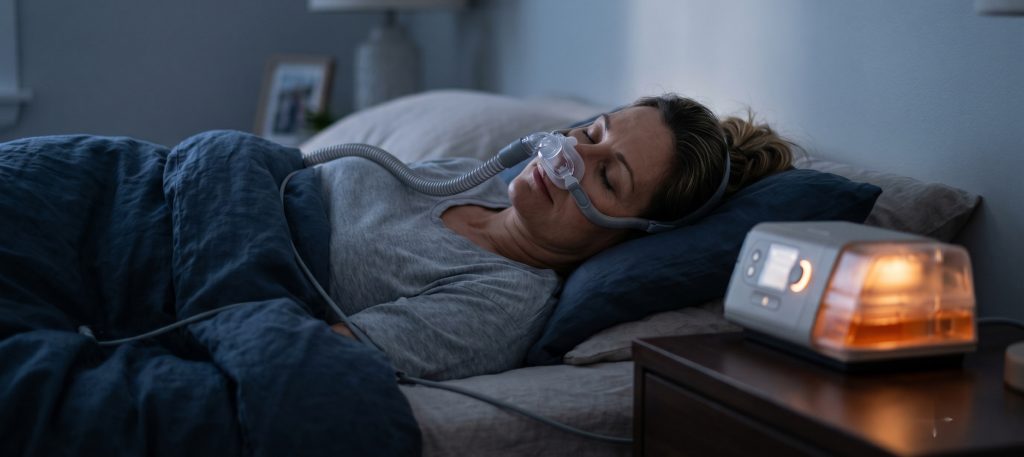
What Is Sleep Apnea?
Sleep apnea is a condition in which breathing repeatedly stops and starts during sleep. These breathing interruptions — called apneas — can last 10 seconds or longer and may occur dozens or even hundreds of times per night.
Each time breathing stops, oxygen levels drop and the brain briefly arouses to restart breathing. Most people are unaware this is happening, but these repeated interruptions prevent restful sleep and place significant stress on the cardiovascular system.
Sleep apnea affects an estimated 25-30% of men and 10-15% of women, though many cases remain undiagnosed.
Types of Sleep Apnea
Obstructive Sleep Apnea (OSA)
The most common form, accounting for approximately 85% of cases. OSA occurs when the muscles in the back of the throat relax during sleep, allowing the soft tissue to collapse and block the airway.
What happens during an obstructive event:
- Throat muscles relax as you enter deeper sleep
- The airway narrows or closes completely
- Airflow stops despite continued breathing effort (your chest and abdomen still move)
- Oxygen levels drop
- Your brain detects the oxygen drop and briefly wakes you to restore muscle tone
- The airway reopens, often with a gasp or snort
- You fall back asleep, and the cycle repeats
Central Sleep Apnea (CSA)
Less common than OSA. In central sleep apnea, the brain temporarily fails to send the signal to breathe. Unlike OSA, there is no physical blockage — the airway is open, but breathing effort stops.
CSA is more common in people with:
- Heart failure
- Stroke history
- Opioid medication use
- High altitude exposure
Complex (Treatment-Emergent) Sleep Apnea
Some people initially diagnosed with OSA develop central apneas after starting CPAP therapy. This combination is called complex or treatment-emergent sleep apnea. It often resolves on its own within weeks to months of continued CPAP use.
Risk Factors
For Obstructive Sleep Apnea
- Excess weight: The strongest risk factor. Fat deposits around the upper airway narrow the breathing passage
- Neck circumference: Greater than 17 inches in men or 16 inches in women increases risk
- Age: Risk increases with age, particularly after 40
- Male sex: Men are 2-3 times more likely to have OSA than premenopausal women (the gap narrows after menopause)
- Family history: Sleep apnea has a genetic component
- Nasal congestion: Chronic congestion or structural issues (deviated septum) increase risk
- Alcohol and sedatives: Relax throat muscles and worsen airway collapse
- Smoking: Increases inflammation and fluid retention in the upper airway
For Central Sleep Apnea
- Heart failure
- Stroke
- Opioid medications
- Male sex
- Age over 60
Symptoms
Sleep apnea symptoms can be subtle. Many people with moderate to severe sleep apnea are unaware they have it.
Nighttime Symptoms
- Loud, chronic snoring (OSA)
- Witnessed pauses in breathing during sleep
- Gasping, choking, or snorting during sleep
- Restless sleep and frequent position changes
- Frequent nighttime urination (nocturia)
- Night sweats
- Dry mouth or sore throat upon waking
Daytime Symptoms
- Excessive daytime sleepiness
- Morning headaches
- Difficulty concentrating and memory problems
- Irritability and mood changes
- Decreased libido
- Falling asleep during quiet activities (reading, watching TV, driving)
Important Note
Not everyone with sleep apnea snores, and not everyone who snores has sleep apnea. Women with sleep apnea are less likely to report classic snoring and more likely to report insomnia, fatigue, and mood symptoms.
Health Consequences of Untreated Sleep Apnea
Sleep apnea is not just a nuisance — untreated moderate to severe OSA is associated with serious health risks. For a detailed look at the evidence behind each of these, see The Health Effects of Sleep Apnea.
- Cardiovascular disease: Hypertension, heart attack, heart failure, atrial fibrillation, stroke
- Metabolic effects: Insulin resistance, type 2 diabetes, weight gain
- Cognitive impairment: Memory problems, difficulty concentrating, increased dementia risk
- Mental health: Depression, anxiety, irritability
- Accidents: Drowsy driving is a significant risk — people with untreated sleep apnea are 2-7 times more likely to be involved in motor vehicle accidents
- Surgical risk: Untreated sleep apnea increases complications from anesthesia and sedation
Diagnosis
Sleep apnea is diagnosed through sleep testing. For a walk-through of what testing involves, see Understanding Your Sleep Study. Your healthcare provider may recommend:
- In-lab polysomnography (PSG): The gold standard — comprehensive overnight monitoring in a sleep lab
- Home sleep apnea test (HSAT): A simplified test completed in your own bed, suitable for suspected moderate to severe OSA
The key diagnostic number is the AHI (Apnea-Hypopnea Index) — the number of breathing events per hour:
| AHI | Classification |
|---|---|
| Less than 5 | Normal |
| 5-14 | Mild OSA |
| 15-29 | Moderate OSA |
| 30+ | Severe OSA |
Treatment Options
CPAP (Continuous Positive Airway Pressure)
The most common and effective treatment for moderate to severe OSA. A CPAP machine delivers pressurized air through a mask, keeping the airway open during sleep.
Effectiveness: When used consistently, CPAP eliminates apneas, normalizes oxygen levels, reduces snoring, and improves daytime alertness. It is associated with reduced cardiovascular risk and improved quality of life.
Challenges: Mask discomfort, dry mouth/nose, and adjustment period. Most people adapt within 2-4 weeks with proper support and mask fitting — our CPAP Setup Guide covers getting started with a new machine.
Oral Appliances (Mandibular Advancement Devices)
Custom-fitted dental devices that hold the lower jaw forward during sleep, preventing airway collapse. They are an alternative for:
- Mild to moderate OSA
- Patients who cannot tolerate CPAP
- Snoring without apnea
Effectiveness is lower than CPAP for moderate to severe cases, but compliance is often better because they are less intrusive.
Positional Therapy
Some people have "positional OSA" — apneas that occur primarily when sleeping on their back. Devices or techniques that encourage side sleeping can reduce events in these cases; see Positional Therapy for Obstructive Sleep Apnea for who is a candidate and which devices help.
Weight Management
For overweight individuals, weight loss can significantly reduce OSA severity. In some cases, substantial weight loss (10-15% of body weight) can resolve mild to moderate OSA entirely. Weight loss is recommended as a complementary approach alongside other treatments.
Surgery
Surgical options exist for specific anatomical causes and for patients who cannot use CPAP or oral appliances:
- UPPP (uvulopalatopharyngoplasty): Removes excess tissue from the throat
- Maxillomandibular advancement: Repositions the jaw to enlarge the airway
- Hypoglossal nerve stimulation (Inspire): An implanted device that stimulates the nerve controlling the tongue to prevent airway collapse
Surgery is typically considered after other treatments have been tried.
Living With Sleep Apnea
- Sleep apnea is a chronic condition that requires ongoing management
- CPAP therapy is most effective when used every night for the entire sleep period
- Regular follow-up with your sleep provider ensures therapy remains optimized
- Weight management, avoiding alcohol before bed, and sleeping on your side can complement treatment
- Inform your healthcare providers about your sleep apnea diagnosis, especially before surgery or sedation procedures
Key Takeaways
- Sleep apnea causes repeated breathing pauses during sleep, disrupting rest and lowering oxygen
- Obstructive sleep apnea (airway collapse) is far more common than central sleep apnea (brain signal issue)
- Key risk factors: excess weight, male sex, age, large neck circumference, family history
- Untreated sleep apnea significantly increases cardiovascular, metabolic, and accident risk
- Diagnosis requires a sleep study — the AHI score determines severity
- CPAP is the most effective treatment; oral appliances and weight loss are alternatives for milder cases
- Consistent treatment dramatically improves health outcomes and quality of life