Why Would You Need a Sleep Study?
Your doctor may order a sleep study if they suspect a sleep disorder based on your symptoms. Common reasons include:
- Loud, chronic snoring
- Witnessed pauses in breathing during sleep
- Excessive daytime sleepiness despite adequate sleep time
- Gasping or choking during sleep
- Difficulty falling or staying asleep that hasn't responded to initial treatment
- Unusual behaviors during sleep (sleepwalking, acting out dreams)
A sleep study provides objective data about what happens in your body while you sleep — information that symptoms and questionnaires alone cannot capture.
Types of Sleep Studies
In-Lab Polysomnography (PSG)
This is the most comprehensive sleep test available. You spend one night at a sleep center while technologists monitor multiple body functions simultaneously.
What it measures:
- Brain wave activity (EEG) — identifies sleep stages and arousals
- Eye movements (EOG) — helps distinguish REM from non-REM sleep
- Muscle activity (EMG) — detects leg movements and REM-related muscle changes
- Heart rhythm (ECG/EKG) — monitors for cardiac irregularities
- Breathing effort — sensors on your chest and abdomen track respiratory movement
- Airflow — a sensor near your nose and mouth measures air movement
- Blood oxygen levels (SpO2) — a finger clip continuously monitors oxygen saturation
- Body position — determines if breathing events occur more in certain positions, which can make positional therapy an option
- Snoring — a microphone records snoring intensity and frequency
When it's used:
- Suspected moderate to severe sleep apnea
- Suspected sleep disorders beyond apnea (narcolepsy, parasomnias, periodic limb movements)
- When a home sleep test was inconclusive
- Patients with significant heart or lung disease
- CPAP titration studies (finding your optimal pressure setting)
Home Sleep Apnea Test (HSAT)
A simplified version that you complete in your own bed. The device is smaller and measures fewer parameters.
What it typically measures:
- Airflow (nasal pressure sensor)
- Breathing effort (chest/abdomen bands)
- Blood oxygen levels (finger sensor)
- Heart rate
- Body position (some devices)
When it's used:
- High suspicion of moderate to severe obstructive sleep apnea in adults
- No significant heart, lung, or neurological conditions
- Patients who prefer testing at home
- As a screening tool before in-lab confirmation
Limitations:
- Cannot detect sleep stages (no EEG), so it may underestimate severity
- Cannot diagnose central sleep apnea, narcolepsy, or parasomnias
- May need to be repeated if results are inconclusive
- If negative but symptoms persist, an in-lab study is typically recommended
What to Expect: In-Lab Study
Before the Study
Scheduling: Sleep studies are usually scheduled for your normal bedtime. Plan to arrive 1-2 hours before your usual sleep time.
Preparation in the days before:
- Avoid caffeine and alcohol for at least 24 hours before the study
- Do not nap on the day of the study
- Wash your hair the day of the study but skip hair products (gels, sprays, conditioner) — these interfere with EEG sensors
- Take your regular medications unless your doctor instructs otherwise
- Bring comfortable sleep clothes, toiletries, and anything you normally use for your bedtime routine
- Bring any prescribed sleep medications to discuss with the technologist
During the Study
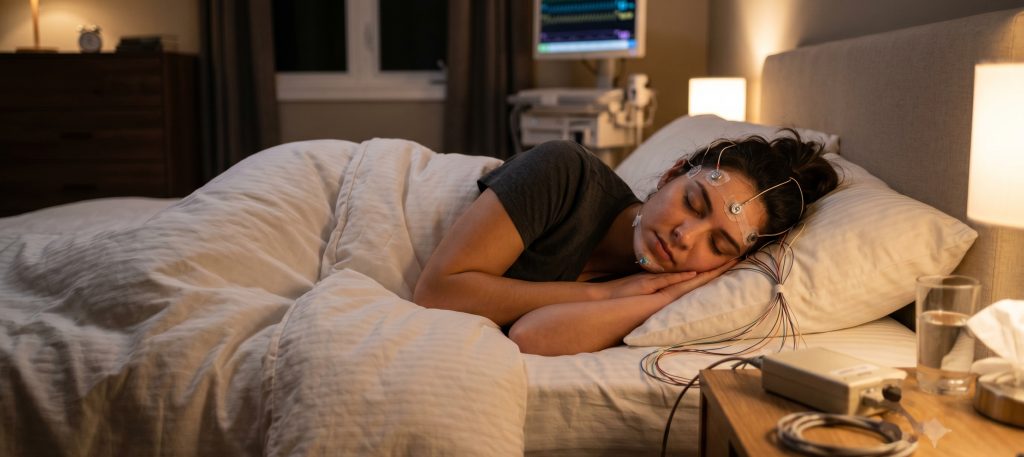
Setup (30-45 minutes): A trained sleep technologist will attach sensors to your body. This includes:
- Small electrodes on your scalp, face, and chin (attached with paste)
- Elastic bands around your chest and abdomen
- A small sensor near your nose and mouth
- An oxygen sensor on your finger
- Electrodes on your legs
The sensors are designed to allow movement. You can roll over, get up to use the bathroom, and shift positions normally. The wires gather at a central connection box near the head of the bed.
Sleeping:
- The room is private, dark, and temperature-controlled
- A technologist monitors your data from another room via camera and sensor feeds
- You do not need to sleep perfectly — even a few hours provides useful data
- If you need something, you can speak and the technologist will hear you
- Most people sleep better than they expect, despite the wires
Morning:
- The technologist wakes you at your normal time (or around 6 AM)
- Sensors are removed — the paste washes out easily with warm water
- The entire process from arrival to departure is typically 8-10 hours
During a CPAP Titration Study
If your initial study shows sleep apnea, your doctor may order a titration study (sometimes the same night as your diagnostic study — called a "split-night" study).
During titration:
- You wear a CPAP mask connected to a machine
- The technologist gradually adjusts the pressure remotely throughout the night
- The goal is to find the lowest pressure that eliminates your breathing events
- You may try different mask types to find the best fit
What to Expect: Home Sleep Test
Setup
Your sleep clinic will provide the device and instructions. Typical steps:
- Apply the nasal cannula (thin tube under your nose)
- Place the effort belt around your chest
- Clip the oxygen sensor on your finger
- Turn on the recording device
- Go to sleep as you normally would
Tips for Accurate Results
- Sleep in your normal position and environment
- Avoid alcohol — it can affect results
- Try to sleep at least 6 hours with the device on
- If a sensor falls off during the night, reattach it if you can
- Return the device to your sleep clinic the next day
Understanding Your Results
Your sleep provider will review the data and provide a detailed report. Here are the key numbers you'll see:
AHI (Apnea-Hypopnea Index)
The most important number in your sleep study. It measures the average number of apneas (complete breathing pauses) and hypopneas (partial breathing reductions) per hour of sleep.
| AHI | Severity |
|---|---|
| Less than 5 | Normal |
| 5-14 | Mild sleep apnea |
| 15-29 | Moderate sleep apnea |
| 30 or higher | Severe sleep apnea |
RDI (Respiratory Disturbance Index)
Similar to AHI but also includes RERAs (Respiratory Effort-Related Arousals) — events where your breathing effort increases enough to briefly wake your brain without a full apnea or hypopnea. The RDI is always equal to or higher than the AHI.
Oxygen Desaturation
Your report will show:
- Lowest SpO2: The lowest your oxygen dropped during the night
- Time below 90%: How many minutes your oxygen was below the normal threshold
- ODI (Oxygen Desaturation Index): Number of times per hour your oxygen dropped by 3% or more
Normal oxygen during sleep stays above 90%. Repeated drops below this level can strain the heart and other organs over time.
Sleep Architecture (In-Lab Only)
Your in-lab report will also show:
- Total sleep time: How long you actually slept
- Sleep efficiency: Percentage of time in bed that you were asleep (normal is above 85%)
- Sleep stages: Percentages of time in N1, N2, N3 (deep), and REM sleep (explained in The Stages of Sleep)
- Sleep latency: How long it took you to fall asleep
- REM latency: How long until your first REM period
- Arousal index: Number of brief awakenings per hour
PLMI (Periodic Limb Movement Index)
Counts leg movements per hour during sleep. An index above 15 may indicate periodic limb movement disorder, which can fragment sleep independently of apnea.
What Happens After Your Sleep Study
- Results review: Your sleep provider typically reviews results within 1-2 weeks
- Diagnosis: Based on the data, you may receive a diagnosis (e.g., obstructive sleep apnea, central sleep apnea, periodic limb movement disorder)
- Treatment plan: For sleep apnea, this usually involves CPAP therapy (see our CPAP Setup Guide for getting started), with the pressure determined either by your titration study or set to auto-adjusting mode
- Follow-up: Most providers schedule a follow-up 1-3 months after starting treatment to review your progress and CPAP data
Common Questions
Will I be able to sleep with all the wires?
Most people do. The first 20-30 minutes may feel unusual, but the technologists are experienced at making you comfortable. Even if your sleep isn't perfect, most studies yield enough data for an accurate diagnosis.
Will I be watched all night?
A technologist monitors your sensor data and has a camera to check if sensors need reattachment. The focus is on your medical data, not observing you personally. The room is private.
Does insurance cover sleep studies?
Most insurance plans cover sleep studies when ordered by a physician for a documented medical concern. Home tests generally cost less than in-lab studies. Check with your insurance provider and sleep clinic about coverage and any required pre-authorization.
Can I take my sleep medication before the study?
Discuss all medications with your sleep provider before the study. Some medications affect sleep architecture and may be adjusted for testing purposes.
What if my home test doesn't show sleep apnea but I still have symptoms?
A negative home test does not rule out sleep apnea — home tests can underestimate severity. Your provider will likely recommend an in-lab polysomnography for a more comprehensive evaluation.
Key Takeaways
- Two main types: in-lab polysomnography (most comprehensive) and home sleep tests (convenient for suspected sleep apnea)
- In-lab studies measure brain waves, breathing, oxygen, heart rhythm, and more
- The AHI is the primary number that determines sleep apnea severity
- You don't need to sleep perfectly — even partial data is usually sufficient
- Normal oxygen should stay above 90% during sleep
- Results are typically available within 1-2 weeks
- A negative home test with persistent symptoms warrants an in-lab study