
Your Brain Doesn't Just Switch Off
Sleep may look passive from the outside, but your brain is remarkably active while you sleep. Throughout the night, you cycle through distinct stages of sleep, each serving different biological functions. Understanding these stages helps explain why the quality of your sleep matters as much as the quantity.
The Four Stages of Sleep
Modern sleep medicine recognizes four stages of sleep, divided into two categories: Non-REM (NREM) sleep and REM sleep.
Stage 1: Light Sleep (N1)
This is the transition between wakefulness and sleep. It typically lasts only 1 to 5 minutes.
- Your muscles begin to relax
- Your heart rate and breathing slow slightly
- Your eyes move slowly
- You can be easily awakened
- You may experience brief muscle twitches (hypnic jerks) — these are completely normal
- Brain waves shift from the active beta and alpha waves of wakefulness to slower theta waves
Stage 1 accounts for roughly 5% of total sleep time in healthy adults.
Stage 2: Stable Sleep (N2)
This is the first stage of true sleep and makes up the largest portion of a normal night.
- Heart rate and breathing continue to slow
- Body temperature drops
- Eye movements stop
- Brain waves slow further, punctuated by brief bursts of activity called sleep spindles and K-complexes
- Sleep spindles are thought to play a role in memory consolidation and learning
- You are less easily awakened than in Stage 1
Stage 2 accounts for approximately 45-55% of total sleep time.
Stage 3: Deep Sleep (N3 / Slow-Wave Sleep)
This is the deepest and most restorative stage of sleep. It is the hardest stage to wake someone from.
- Brain waves slow dramatically into large, slow delta waves
- Heart rate and breathing reach their lowest levels
- Muscles are completely relaxed
- The body focuses on physical restoration:
- Growth hormone is released (critical for tissue repair and immune function)
- Cellular repair processes peak
- The glymphatic system clears metabolic waste from the brain, including beta-amyloid proteins associated with Alzheimer's disease
- Memory consolidation occurs, particularly for factual and declarative memories
Deep sleep accounts for about 15-25% of total sleep time. You get more deep sleep earlier in the night and less as the night progresses.
REM Sleep (R)
REM stands for Rapid Eye Movement. This is the stage most associated with vivid dreaming.
- Your eyes move rapidly behind closed eyelids
- Brain activity increases dramatically — it resembles wakefulness on an EEG
- Heart rate and breathing become irregular
- Most voluntary muscles are temporarily paralyzed (called atonia) — this prevents you from acting out your dreams
- Emotional memory processing and consolidation occurs
- REM sleep is thought to support creativity, problem-solving, and emotional regulation
REM sleep accounts for about 20-25% of total sleep time. REM periods get longer as the night progresses — your longest REM periods occur in the final hours of sleep.
Sleep Cycles: How the Stages Fit Together
You don't go through the stages once and stop. Instead, you cycle through them repeatedly throughout the night.
A single sleep cycle typically lasts about 90 minutes and follows this general pattern:
N1 → N2 → N3 → N2 → REM
Most adults complete 4 to 6 complete cycles per night. However, the composition of each cycle changes:
- Early cycles (first half of the night) are dominated by deep sleep (N3)
- Later cycles (second half of the night) are dominated by REM sleep
- Deep sleep decreases and REM increases as the night progresses
This is why cutting your sleep short primarily costs you REM sleep, while going to bed too late may reduce your deep sleep.
Reading a Hypnogram
A hypnogram is a chart that shows how you move through sleep stages during the night. Sleep studies produce these, and many consumer sleep trackers generate a simplified version. Here is what a typical healthy adult's hypnogram looks like:
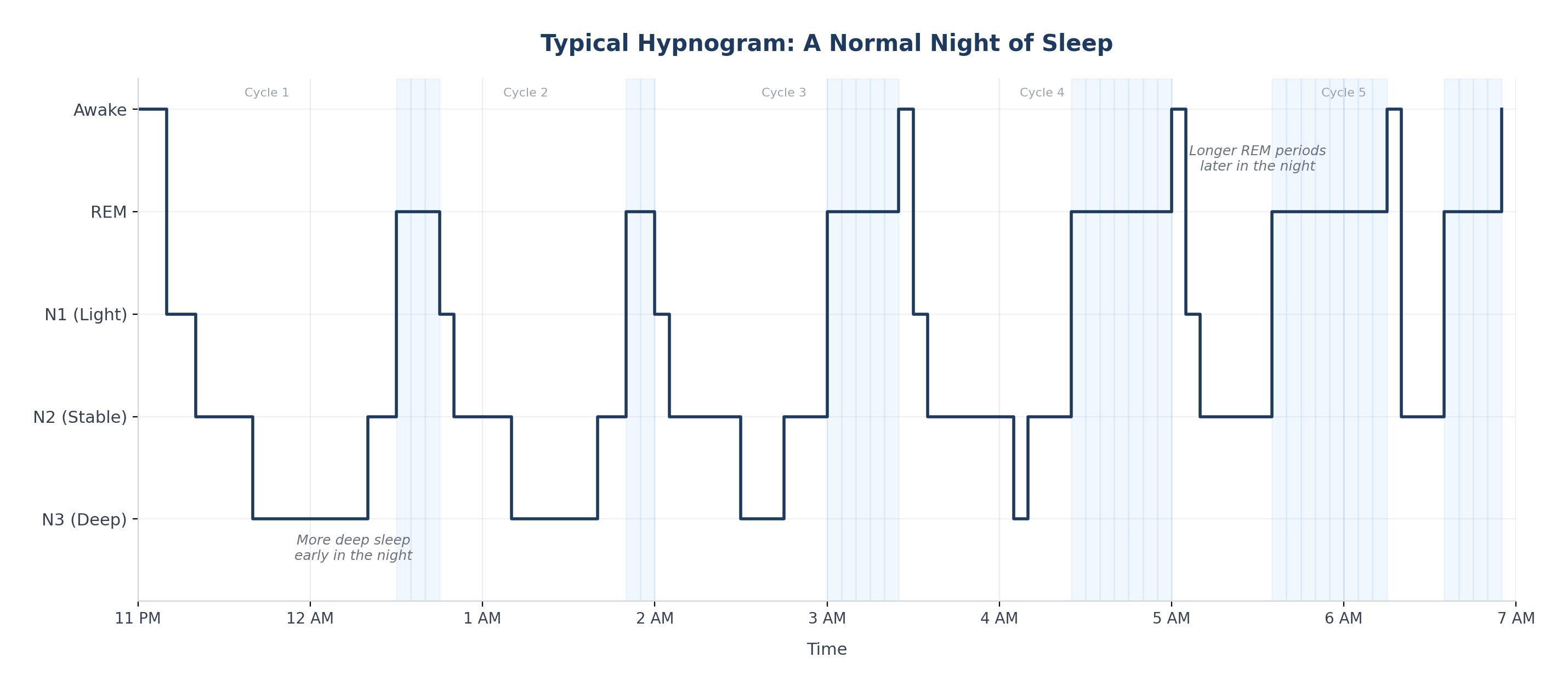
Notice how the pattern changes across the night:
- Cycles 1 and 2 (roughly 11 PM to 2 AM) dip deep into N3 — this is when most of your physical restoration happens
- Cycles 3 through 5 (roughly 2 AM to 7 AM) spend progressively more time in REM — this is when emotional processing and memory consolidation peak
- Brief awakenings between cycles are normal and usually too short to remember
- Each cycle lasts approximately 90 minutes, though this varies from person to person
If you use a sleep tracker that shows your sleep stages, look for this general pattern rather than fixating on exact percentages. A healthy night includes a smooth progression from deep-sleep-dominant early cycles to REM-dominant later cycles.
Why Each Stage Matters
| Stage | Primary Functions |
|---|---|
| N1 | Transition to sleep; brief and light |
| N2 | Memory consolidation; body maintenance begins |
| N3 (Deep) | Physical restoration; immune function; brain waste clearance; growth hormone |
| REM | Emotional processing; creativity; learning consolidation; dreaming |
No single stage is more "important" than the others — your body needs all of them in the right proportions.
What Disrupts Sleep Stages
Several factors can alter your normal stage distribution:
- Alcohol suppresses REM sleep, especially in the first half of the night. This is why you may feel unrested after drinking even if you slept for 8 hours.
- Caffeine reduces deep sleep even when consumed 6 hours before bed.
- Sleep apnea fragments sleep and reduces time in deep sleep and REM.
- Aging naturally reduces the amount of deep sleep. Older adults spend less time in N3 and more time in lighter stages — see Sleep and Aging for what to expect.
- Medications including some antidepressants, beta-blockers, and antihistamines can alter sleep architecture.
- Chronic sleep deprivation causes a rebound effect — when you finally get adequate sleep, your body prioritizes the stages it was missing most.
How Much Deep Sleep and REM Do You Need?
There are no precise, universally agreed-upon targets. However, general guidelines suggest:
- Deep sleep: 1-2 hours per night for most adults
- REM sleep: 1.5-2 hours per night for most adults
Sleep trackers and wearable devices estimate these stages with varying accuracy. Consumer devices can give you a general trend over time but are not as precise as a clinical polysomnography (sleep study). Focus on how you feel rather than chasing exact stage percentages.
Key Takeaways
- Sleep consists of four stages that cycle approximately every 90 minutes
- Deep sleep (N3) is most important for physical restoration and occurs mostly in the first half of the night
- REM sleep is most important for emotional processing and occurs mostly in the second half of the night
- Alcohol, caffeine, sleep disorders, and aging all affect your sleep stage distribution
- Both sleep quantity and quality (the right balance of stages) matter for feeling rested