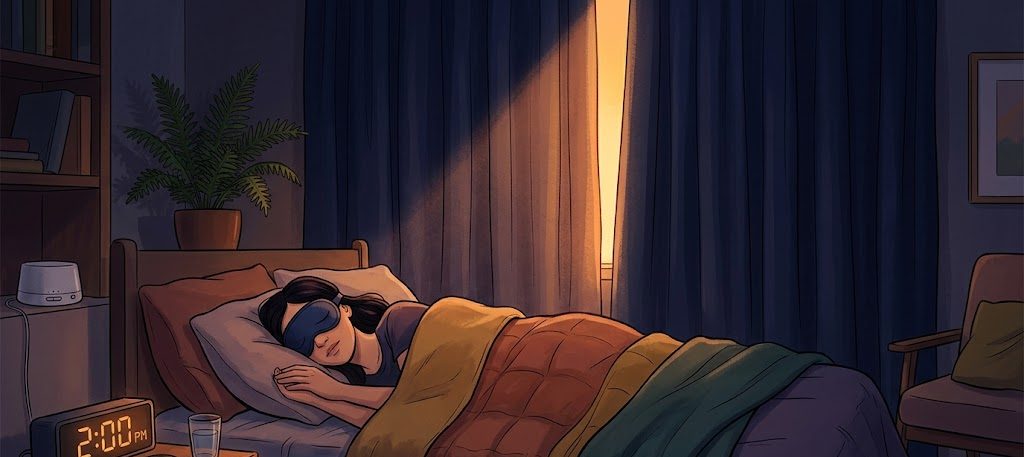
Just finished a night shift?
- Sunglasses on for the ride home — morning light tells your brain the day is starting, which is exactly the wrong message
- Light snack only, not a full meal
- Straight to bed — dark (blackout curtains or a sleep mask), cool, phone on Do Not Disturb
- If you wake after 4–5 hours and can't get back to sleep, get up — then take a 20-minute nap later rather than lying there
- Working again tonight? A 90-minute nap around 7–8 PM is the single best prep
Want this on paper? Download the free one-page Night Shift Survival Card — before/during/after-shift steps you can tape inside your locker.
Written for People Who Can't Just "Sleep at Night"
You already know shift work is hard on you — you don't need another article telling you so. What you need are tactics that survive contact with real schedules, real coworkers, and a real life happening in daylight. That's what this guide is: the specific, evidence-based moves for night shifts, rotating shifts, and early starts, plus fallbacks for when the textbook advice ("sleep immediately when you get home") collides with kids, deliveries, and lawnmowers.
Everything here comes from clinical guidelines for shift work disorder — the short explanation of why these strategies work is at the end, after the parts you came for.
Sleep Strategies by Shift Type
Night Shifts (e.g., 11 PM - 7 AM)
Before your shift:
- Sleep as late as possible before your first night shift
- Consider a 90-minute nap in the early evening (around 7-8 PM) before your shift starts
- Expose yourself to bright light before and during the first half of your shift to delay your circadian rhythm
During your shift:
- Use bright lighting in your workspace, especially during the first half of the shift
- Strategic caffeine use: consume caffeine in the first half of your shift (before 3 AM for a typical night shift). Avoid caffeine in the last 4-5 hours before your planned sleep time
- Take a 20-minute nap during your break if permitted — even brief naps significantly improve alertness
After your shift:
- Wear dark sunglasses on your commute home — morning sunlight will signal your brain to wake up
- Avoid heavy meals right before bed, but don't go to bed hungry
- Go to sleep as soon as possible after arriving home
- Keep your sleep environment dark, cool, and quiet
Rotating Shifts
Rotating schedules are the most challenging because your body never fully adjusts to one pattern.
If you have any say in your schedule:
- Ask for rotations that move forward (day → evening → night) rather than backward. Forward rotations align better with the natural tendency to delay sleep
- Ask for at least 2 days between shift changes
If you don't control your schedule (most nurses, first responders, and plant workers don't), the two strategies that work regardless:
- Anchor sleep: protect a core 4-hour block of sleep at the same clock time every single day — work days and days off alike. Your body clock can hold onto this anchor even when everything else moves
- On days off, sleep on a schedule that splits the difference between your work schedule and a normal one, rather than flipping fully back and forth
Early Morning Shifts (e.g., 4 AM - 12 PM)
- Go to bed early enough to get 7-8 hours — this may mean being in bed by 7:30-8:00 PM
- Dim lights and avoid screens for 1-2 hours before your early bedtime
- Avoid caffeine after noon
- Bright light exposure at the start of your shift helps promote alertness
When the Ideal Isn't Possible
Most shift-work advice assumes you can sleep on cue in a silent house. Real life doesn't cooperate, so here are the fallbacks:
You can't go straight to bed after a night shift (school run, kids, appointments): split your sleep instead. Take the longest block you can get in the morning — even 3–4 hours in a dark room helps enormously — then add a 60–90 minute nap in the late afternoon or before your next shift. Two blocks totaling 7 hours beats one frustrated block of 5.
Daytime noise you can't control (construction, deliveries, housemates): combine earplugs and white noise rather than choosing one; sleep in the quietest room in the home even if it isn't the bedroom; and treat the last 4 hours of your sleep block as the most fragile — schedule deliveries and calls outside it if you can.
You can't nap at work: front-load caffeine at the start of the shift, use the brightest workspace available for the first half, and get moving (stairs, a brisk walk) during the circadian low point around 3–5 AM. Then protect a 20-minute nap before driving home if you're struggling — a drowsy commute is the single most dangerous part of shift work.
Coming off your last night shift of a stretch (the hardest transition there is): don't sleep the whole day. Take a short 2–3 hour "recovery nap" in the morning, get up, get outside into daylight, stay active, then go to bed at a normal-ish hour that evening. You'll be tired that day — but you'll wake the next morning roughly back on a day schedule, instead of lying awake at 3 AM having slept until mid-afternoon.
Creating an Optimal Sleep Environment
Your sleep environment matters even more for shift workers because you're fighting your circadian rhythm.
Darkness
- Install blackout curtains or use a blackout sleep mask — this is the single most impactful change you can make
- Cover any light-emitting electronics in your bedroom
- Consider light-blocking tape for small indicator lights
Noise
- Use earplugs, a white noise machine, or both
- Inform household members of your sleep schedule
- Consider disconnecting the doorbell or posting a "day sleeper" sign
- A fan provides both white noise and cooling
Temperature
- Keep your bedroom cool (65-68 degrees Fahrenheit / 18-20 Celsius)
- Your core body temperature naturally drops during sleep — a cool room supports this process
Phone and Interruptions
- Set your phone to "Do Not Disturb" with exceptions only for true emergencies
- Let important contacts know how to reach you in a real emergency
Light Management: Your Most Powerful Tool
Strategic light exposure is the most effective way to shift your circadian rhythm.
To delay your rhythm (for night shift workers):
- Expose yourself to bright light in the evening and early night
- Avoid bright light in the morning after your shift (wear sunglasses)
- Bright light therapy lamps (10,000 lux) can be used during the first half of your shift
To advance your rhythm (for early morning shifts):
- Get bright light exposure as early as possible in the morning
- Avoid bright light in the evening
- Dim your home lights 2-3 hours before bed
Caffeine: Strategic, Not Constant
Caffeine can be a valuable tool when used correctly:
- Consume caffeine at the start of your shift or during the first half
- A moderate dose (200-400 mg, equivalent to 1-2 cups of coffee) is effective
- Stop caffeine at least 5-6 hours before your planned sleep time
- Avoid using caffeine to compensate for severe sleep deprivation — address the root cause instead
Napping Strategically
Naps are one of the most effective countermeasures for shift work fatigue:
- A 20-minute nap provides significant alertness benefits without grogginess
- A 90-minute nap allows a full sleep cycle and can be beneficial before a night shift
- Avoid naps longer than 20 minutes but shorter than 90 minutes, as waking during deep sleep causes grogginess (sleep inertia)
- Nap in a dark, quiet location when possible
Why These Strategies Work: Your Body Clock
Everything above comes down to one mechanism. Your body runs on an internal clock — the circadian rhythm — a roughly 24-hour cycle, set primarily by light, that controls when you feel sleepy and alert, your body temperature, and the hormones that drive sleep (melatonin) and wakefulness (cortisol).
For most people this clock promotes deep sleep between about 2:00–6:00 AM, with a secondary alertness dip around 1:00–3:00 PM. As a shift worker you're often trying to sleep during your clock's "alert" phase and work during its "sleep" phase — that mismatch is the core problem. Light management shifts the clock, anchor sleep steadies it, and strategic caffeine and naps bridge the hours the clock refuses to cover.
See it work: the interactive two-process exhibit shows why a daytime sleep attempt so often fails while the same attempt after a lost night succeeds instantly — and why the sleepiness of a night shift eases after dawn even though you have been awake longer.
When to Seek Help
Consider speaking with a healthcare provider if you experience:
- Persistent excessive sleepiness despite following these strategies
- Difficulty staying awake during your commute
- Regularly falling asleep unintentionally
- Significant mood changes, irritability, or difficulty concentrating
- Gastrointestinal problems related to your schedule
You may have shift work disorder, a recognized circadian rhythm sleep disorder. Treatments may include prescribed melatonin timing, light therapy protocols, or other interventions tailored to your specific schedule.
Key Takeaways
- Light management (bright light during shifts, darkness for sleep) is your most powerful tool
- Blackout curtains or a sleep mask are essential investments
- Use caffeine strategically — early in your shift, not throughout
- Short naps (20 minutes) before or during shifts significantly improve alertness
- Forward-rotating shift schedules are easier to adapt to than backward rotations
- Maintain consistent sleep patterns as much as your schedule allows — anchor sleep works even without schedule control
- Seek medical help if fatigue persists despite good sleep practices
- Print the one-page Night Shift Survival Card for the before/during/after-shift steps at a glance