What Is Light Therapy?
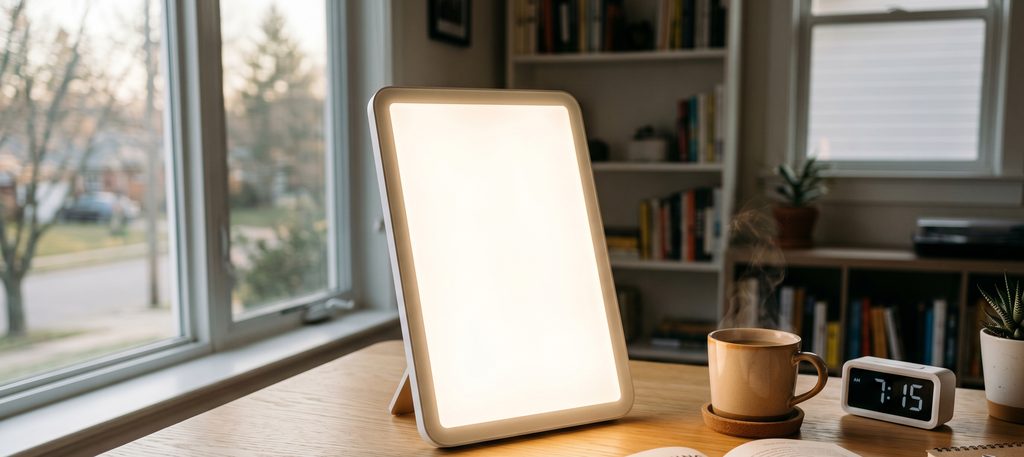
Light therapy — also called bright light therapy or phototherapy — uses controlled exposure to bright light at specific times of day to shift the timing of your circadian clock. Unlike medication, light therapy works by mimicking the strongest natural signal your brain uses to tell time: the rising and setting of the sun.
For the underlying biology of how the eye sends timing information to the brain, see How Light Sets the Clock in Circadian Rhythm Explained. This article focuses on the practical question: how to actually use light therapy to treat a circadian problem.
Light therapy is a first-line, evidence-based treatment for:
- Delayed Sleep-Wake Phase Disorder (DSPD) — body clock runs too late
- Advanced Sleep-Wake Phase Disorder (ASWPD) — body clock runs too early
- Shift Work Disorder — misalignment with night/rotating shifts
- Jet Lag Disorder — temporary misalignment from travel
- Non-24-Hour Sleep-Wake Disorder — free-running clock (most common in totally blind individuals)
- Seasonal Affective Disorder (SAD) — winter-pattern depression
The One Rule That Determines Everything: Timing
If you remember nothing else, remember this: the timing of light exposure determines whether your clock moves earlier, later, or not at all. Lux matters, duration matters, but timing is what makes light therapy work or fail.
The circadian clock has two windows each 24 hours:
- The advance window — light during the late night and early morning pulls your clock earlier. Use this when you need to fall asleep earlier and wake earlier.
- The delay window — light during the late afternoon and evening pushes your clock later. Use this when you need to fall asleep later and wake later.
There is also a dead zone in the middle of the day where light has little phase-shifting effect (though it still helps with alertness, mood, and reinforcing the rhythm overall).
The single most important caveat: these windows are anchored to your body clock, not the wall clock. Someone with DSPD whose body clock thinks 4 AM is midnight needs to use light at 8–9 AM, not 5 AM. Light delivered before your internal core body temperature minimum (CBTmin) delays the clock; light delivered after CBTmin advances it. CBTmin sits roughly 2 hours before your natural wake time. Getting this wrong is the single biggest cause of light therapy "not working."
Equipment: What Actually Counts as Light Therapy
You need light that is bright enough, the right wavelength range, and delivered close enough to your eyes — but not so close that it causes glare or strain.
Lux: how bright is enough?
- 10,000 lux at the position of your eyes is the standard prescribed intensity. Most clinical trials use this dose.
- 2,500–5,000 lux can work but requires longer exposure (often 1–2 hours).
- Ordinary indoor lighting is typically only 100–500 lux — orders of magnitude too dim to reliably phase-shift the clock.
- Outdoor daylight, even on an overcast day, is 5,000–20,000 lux. Outdoors for 30+ minutes in the right window is often as effective as a light box, and free.
Lux falls off rapidly with distance. A box rated "10,000 lux" usually means 10,000 lux at a specific distance (often 12–18 inches / 30–45 cm). Doubling the distance roughly quarters the intensity.
Light box features to look for
- Output of ≥10,000 lux at a comfortable working distance
- Diffused white light (not raw LEDs you stare into) with a viewing surface of at least ~12 inches (30 cm) square — larger surfaces are more forgiving of head movement
- UV-filtered — modern boxes use LED or filtered fluorescent and emit negligible UV
- Color temperature around 4,000–6,500 K is standard. Newer "blue-enriched" boxes work at lower total lux because the SCN is most sensitive to short-wavelength light near 480 nm, but for most users a standard white box at 10,000 lux is well-studied and well-tolerated.
How to use a light box
- Place the box off to the side at about a 30–45° angle, roughly arm's length away, with the light source above eye level.
- Keep your eyes open and pointed forward. You do not stare into the light — peripheral exposure is enough.
- Read, eat breakfast, work, or use a screen during the session. The session is the dose; what you do during it doesn't matter.
- Standard session: 30 minutes at 10,000 lux. Some protocols use 45–60 minutes; longer at lower intensity is also acceptable.
- Use daily, at the same time, for at least 2–4 weeks before judging whether it is working. Effects accumulate.
Dawn simulators
A dawn simulator is a bedside lamp that gradually brightens over 30–60 minutes before your alarm, simulating sunrise. Peak intensity is much lower than a light box (typically 250–400 lux), but the timing — through closed eyelids in the last hour of sleep — has been shown to produce modest phase advances and improve morning alertness, particularly in ASWPD and winter SAD. Useful as an adjunct or for people who cannot sit with a light box.
Condition-by-Condition Protocols
Delayed Sleep-Wake Phase Disorder (DSPD)
Goal: advance the clock earlier.
- Use light immediately upon natural waking, then nudge wake time earlier by 15–30 minutes per day.
- Starting too early is the classic mistake. If your natural wake is 11 AM, start light therapy at 11 AM, not 7 AM. Then shift it earlier as your clock follows.
- 30 minutes at 10,000 lux daily, paired with avoiding bright light in the evening (dim home lighting, blue-light blockers, or amber glasses 2–3 hours before target bedtime).
- Often combined with low-dose melatonin (0.3–0.5 mg) 5–7 hours before target bedtime, per AASM guidance.
- See Delayed Sleep Phase Syndrome for the full diagnostic picture.
Advanced Sleep-Wake Phase Disorder (ASWPD)
Goal: delay the clock later.
- Use light in the late afternoon and evening, typically 7–9 PM, for 30–60 minutes.
- Avoid bright light in the early morning (sunglasses outdoors before mid-morning if you wake very early).
- More common in older adults; results can be modest but real.
- See Advanced Sleep Phase Disorder.
Shift Work Disorder
Goal: shift the clock toward the work schedule, or at least improve alertness during shifts.
- Permanent night shift: bright light during the first half of the shift to push the clock later; wear dark sunglasses on the commute home to protect against the morning light that would shift it back.
- Rotating shift: full circadian adaptation is usually impossible. Use light strategically for alertness during the shift and protect daytime sleep with blackout curtains and dark commute home.
- See Shift Work Disorder and Sleep for Shift Workers.
Jet Lag
- Eastbound (need to advance): seek bright light in the destination morning; avoid evening light.
- Westbound (need to delay): seek bright light in the destination afternoon and early evening; avoid early-morning light.
- The first day after a long flight, timing must account for where your body clock still is, not local time — see Jet Lag Disorder for a worked example.
Non-24-Hour Sleep-Wake Disorder
- In sighted individuals, daily morning bright light is the cornerstone of treatment, with the goal of entraining the free-running clock to a 24-hour cycle.
- In totally blind individuals, light therapy is generally ineffective because the photic pathway to the SCN is absent. Timed melatonin (or the melatonin agonist tasimelteon) is the primary treatment.
- See Non-24-Hour Sleep-Wake Disorder.
Seasonal Affective Disorder (SAD)
SAD is technically a depression diagnosis rather than a circadian sleep disorder, but it is the indication with the largest light-therapy evidence base.
- 30 minutes at 10,000 lux, within the first hour of waking, daily through the dark season.
- Response is typically seen within 1–2 weeks. Continue until natural daylight is sufficient (often through April/May).
- Light therapy is comparably effective to antidepressants in many SAD trials, with effects appearing faster.
Irregular Sleep-Wake Rhythm
- Brief sessions of bright light in the morning, combined with strict avoidance of late-day napping and exposure to evening light, can consolidate the rhythm. Most evidence comes from dementia populations where structured daytime light improves sleep consolidation.
- See Irregular Sleep-Wake Rhythm.
Side Effects and Safety
Light therapy is well-tolerated by most people, but is not risk-free.
Common, usually mild:
- Eye strain or dryness
- Headache (often resolves with shorter sessions or greater distance)
- Nausea
- Jitteriness or feeling "wired"
- Skin warming if very close to the source
Take more seriously:
- Bipolar disorder — light therapy can trigger hypomania or mania. Use only under psychiatric supervision.
- Retinal disease, macular degeneration, or recent eye surgery — discuss with an ophthalmologist first.
- Photosensitizing medications — lithium, some antibiotics (tetracyclines, fluoroquinolones), some antipsychotics, certain antidepressants (especially St. John's wort), and isotretinoin can increase photosensitivity. Most modern UV-filtered light boxes are safe but discuss with your prescriber.
- Migraine — bright light can be a trigger.
If light therapy produces irritability, racing thoughts, or sleep onset shifting in the wrong direction, stop and consult a sleep specialist. The most likely cause is incorrect timing relative to your CBTmin.
How Long Until It Works?
- SAD: improvement in 1–2 weeks, full response within 2–4 weeks.
- DSPD / ASWPD: measurable phase shifts within a week, but consolidating a new schedule typically takes 2–4 weeks of consistent use plus simultaneous behavioral changes (consistent wake time, avoiding off-target light, often timed melatonin).
- Jet lag: effects within 1–3 days at the destination.
- Shift work: during-shift alertness benefits are immediate; circadian adaptation depends heavily on the schedule and on protecting sleep from daytime light.
The most common reasons light therapy "doesn't work" are: wrong timing (relative to body clock, not wall clock), not enough lux at the eyes (sitting too far, looking away), too short a trial (less than 2 weeks), and uncontrolled exposure to off-target light (e.g., doing morning light therapy but also using a bright phone at midnight).
When to See a Specialist
Self-directed light therapy is reasonable for SAD and jet lag. For an intrinsic circadian rhythm disorder (DSPD, ASWPD, non-24, irregular rhythm) you should generally work with a sleep medicine physician or behavioral sleep specialist. They can:
- Confirm the diagnosis with a sleep diary, actigraphy, or DLMO (dim light melatonin onset) testing
- Estimate your CBTmin to time light correctly
- Co-prescribe low-dose melatonin and behavioral changes
- Adjust the protocol if it stalls
Key Takeaways
- Timing relative to your body clock is the single most important variable. Morning light advances the clock; evening light delays it; light at the wrong time can make things worse.
- 10,000 lux for 30 minutes daily is the standard dose; outdoor light for 30+ minutes is an effective free substitute.
- The eyes need to be open and facing the source, but you do not need to stare into the light.
- Light therapy is first-line for SAD and a core component of treatment for DSPD, ASWPD, shift work, jet lag, and non-24.
- Allow 2–4 weeks of consistent use before judging whether it is working.
- Bipolar disorder, retinal conditions, and photosensitizing medications all warrant clinician input first.
- For the underlying biology — ipRGCs, melanopsin, the SCN, and the phase response curve — see Circadian Rhythm Explained.