
Does it actually work?
- Yes — this is among the best-tested treatments for chronic insomnia. Sleep restriction is a core component of cognitive behavioral therapy for insomnia (CBT-I), which every major guideline recommends trying before sleeping pills
- In randomized trials, sleep restriction produces large reductions in insomnia severity, and roughly 7–8 out of 10 people who complete CBT-I improve meaningfully — in meta-analyses, time to fall asleep drops by about 20 minutes and nighttime waking by about 30 minutes
- Unlike medication, the benefits persist after treatment ends
- Expect the first 1–2 weeks to be genuinely hard (more daytime sleepiness) before it gets better — that early sleepiness means it's working
- Plan on 2–4 weeks for real improvement, 6–8 for full benefit
What Is Sleep Restriction Therapy?
Sleep restriction therapy (SRT) is one of the most effective components of cognitive behavioral therapy for insomnia (CBT-I). The core idea is simple: if you are spending 9 hours in bed but only sleeping 6, your sleep is spread thin and fragmented. By temporarily limiting your time in bed to match the amount you actually sleep, you build up sleep pressure that leads to deeper, more consolidated sleep.
Despite the name, sleep restriction does not aim to reduce how much you sleep. It reduces the time you spend in bed awake. As your sleep becomes more efficient, your time in bed is gradually expanded until you reach a sustainable schedule.
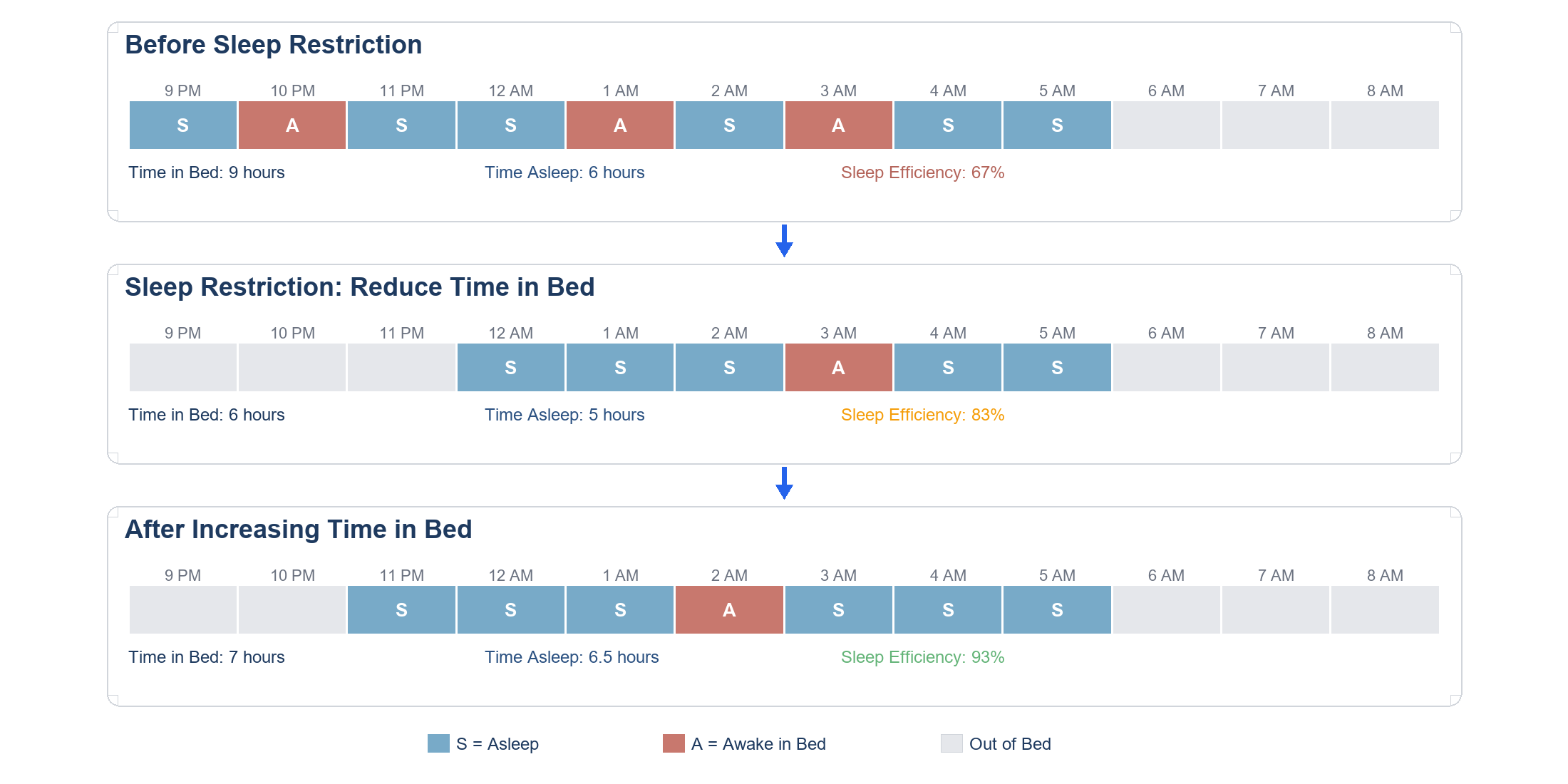
See it work: the interactive sleep restriction exhibit lets you put in your own bedtime and wake time, then walks through it in four steps — your night now, the week the window shrinks, the 15-minute expansions, and where it settles — with one bar per step.
Why Does It Work?
Sleep restriction works through two mechanisms:
- Increased sleep drive — spending less time in bed means more of the natural pressure to sleep builds up during your waking hours, making it easier to fall asleep and stay asleep (researchers call this homeostatic sleep pressure — the two-process exhibit shows this pressure and the body clock as two curves you can move)
- Circadian alignment — a fixed wake time anchors your internal clock, which stabilizes when you feel sleepy at night
The first week is often the hardest. You may feel more tired than usual as your body adjusts. This is temporary and expected — it is the sleep pressure building up that will ultimately consolidate your sleep.
Before You Start
Keep a Sleep Diary First
You need at least one week of sleep diary data before beginning sleep restriction. Our free printable 2-Week Sleep Diary Worksheet is built for exactly this — it includes the daily tracking tables and a page that walks you through the calculations used below. Each morning, record:
- What time you got into bed
- What time you tried to fall asleep
- Roughly how long it took to fall asleep (sleep onset latency)
- How many times you woke during the night and for how long
- What time you woke up for the last time
- What time you got out of bed
From this data, calculate your average total sleep time (TST) — the total hours you estimate you actually slept per night, averaged across the week.
Important Safety Notes
Sleep restriction is safe for most adults, but you should work with a healthcare provider rather than trying it alone if any of the following apply — including the ones you're not sure about:
- You have epilepsy or a seizure disorder, or have ever had an unexplained seizure (sleep deprivation can lower the seizure threshold)
- You have bipolar disorder — or have ever had a stretch of days with unusually little need for sleep alongside racing thoughts, big plans, or uncharacteristic spending (possible hypomania that was never diagnosed; sleep restriction can trigger manic episodes)
- You have a job that requires high vigilance — driving, operating heavy machinery, flying
- You have untreated sleep apnea — or you snore loudly, someone has seen you stop breathing in your sleep, or you wake gasping (get this evaluated first)
- You are pregnant
A caution for everyone, not just the list above: during the first weeks your daytime sleepiness will genuinely increase. Treat yourself as you would after a bad night — be careful behind the wheel, avoid long drives when you can, and pull over if you're fighting sleep. This phase passes, but it's real while it lasts.
Even if none of these apply, working with a therapist trained in CBT-I is ideal. They can guide adjustments and provide support during the difficult first weeks.
Step-by-Step: Setting Your Initial Sleep Window
Step 1: Calculate Your Average Total Sleep Time
Add up your estimated total sleep time from each night of your sleep diary and divide by the number of nights.
Example: If your diary shows you slept approximately 5.5, 6, 5, 6.5, 5, 6, and 5.5 hours over seven nights, your average total sleep time is about 5.6 hours.
Step 2: Set Your Time in Bed (TIB)
Your initial time in bed equals your average total sleep time — but never less than 5 hours, regardless of how little you report sleeping. This minimum is a safety floor.
If that number looks frighteningly small, two reassurances: this window is temporary and expands week by week as your sleep improves, and the extra sleepiness you'll feel at first is the treatment working — most people see meaningful improvement within 2–4 weeks.
In our example: initial TIB = 5.6 hours, which we can round to 5 hours 45 minutes or 6 hours.
Step 3: Choose a Fixed Wake Time
Pick a wake time that works for your life every day, including weekends. This is the anchor of the entire program.
Example: Wake time = 6:30 AM
Step 4: Calculate Your Bedtime
Subtract your TIB from your wake time.
Example: 6:30 AM minus 6 hours = 12:30 AM bedtime
This means you should not get into bed before 12:30 AM and must get out of bed at 6:30 AM every day.
Step 5: Follow the Schedule Strictly
- Do not get into bed before your scheduled bedtime, even if you feel sleepy earlier
- If you do not feel sleepy at your scheduled bedtime, wait until you do — but still get up at your fixed wake time
- No napping during the day
- Get out of bed at your scheduled wake time every day, no matter how you slept
Week-by-Week Adjustments
At the end of each week, calculate your sleep efficiency:
Sleep Efficiency = (Total Sleep Time / Time in Bed) x 100
Worked example: you were in bed 6.5 hours and slept about 5.5 of them → 5.5 ÷ 6.5 × 100 = 85%, so you'd expand your window by 15 minutes next week.
The one-page Sleep Restriction Worksheet has the baseline calculation, an 8-week tracking grid, and these adjustment rules printed on it — useful to keep on the nightstand. Adjust your sleep window based on your average sleep efficiency for the week:
If Sleep Efficiency Is 85% or Higher
Expand your time in bed by 15-30 minutes. You can do this by moving your bedtime earlier (keep wake time fixed).
If Sleep Efficiency Is Between 80-85%
Keep the same schedule for another week.
If Sleep Efficiency Is Below 80%
Reduce your time in bed by 15 minutes — but never below 5 hours. Move your bedtime later.
Example Progression
| Week | Bedtime | Wake Time | TIB | Avg TST | Sleep Efficiency | Action |
|---|---|---|---|---|---|---|
| 1 | 12:30 AM | 6:30 AM | 6h | 5h 20m | 89% | Expand |
| 2 | 12:00 AM | 6:30 AM | 6.5h | 5h 50m | 90% | Expand |
| 3 | 11:30 PM | 6:30 AM | 7h | 6h 10m | 88% | Expand |
| 4 | 11:15 PM | 6:30 AM | 7.25h | 6h 30m | 90% | Expand |
| 5 | 11:00 PM | 6:30 AM | 7.5h | 6h 50m | 91% | Expand |
| 6 | 10:45 PM | 6:30 AM | 7.75h | 6h 40m | 86% | Expand |
Continue adjusting until you find a schedule that gives you enough sleep with consistently high efficiency (85%+).
What to Expect
Week 1-2: The Hard Part
- You will likely feel sleepier during the day than you did before starting
- You may fall asleep faster and wake less during the night
- Your sleep will begin to consolidate into a solid block
- Daytime functioning may temporarily dip — this is normal
Week 3-4: Sleep Starts Improving
- Sleep onset should become quicker and more reliable
- Middle-of-the-night awakenings typically decrease
- You begin to associate the bed with sleeping, not lying awake
- Confidence in your ability to sleep starts to rebuild
Week 5+: Maintenance
- Your sleep window gradually expands toward a sustainable schedule
- Sleep efficiency stays high
- You have a clear, personalized schedule you can maintain long-term
Common Questions
Will I not be even more tired?
The first 1-2 weeks can be tougher, yes. But most people find that even with fewer hours in bed, they are sleeping more efficiently and feeling better rested than when they were spending 9-10 hours in bed and sleeping poorly.
What if I cannot stay awake until my bedtime?
Do a quiet, non-stimulating activity in dim light — reading, listening to a podcast, gentle stretching. Stay out of bed. If you are genuinely struggling to stay awake, this means your sleep drive is building exactly as intended.
Can I adjust my wake time on weekends?
No. A fixed wake time is the most important part of the program. Even 1-2 hours of variation on weekends can undo progress by shifting your circadian rhythm.
How long does sleep restriction take to work?
Most people see meaningful improvement within 2-4 weeks. Full benefit typically takes 6-8 weeks. The key is consistency — partial compliance leads to partial results.
Combining With Other CBT-I Techniques
Sleep restriction is most effective when combined with:
- Stimulus control — retraining the association between bed and sleep
- Cognitive restructuring — addressing the anxious thoughts about sleep that can undermine the process
- Sleep hygiene — ensuring your habits and environment support the program
Together, these components form the complete CBT-I approach that is recommended as the first-line treatment for chronic insomnia.
How to Find a CBT-I Provider
"Work with a professional" is only useful advice if you can find one, so here is the actual path:
- Search the Society of Behavioral Sleep Medicine directory — therapists and psychologists specifically trained in CBT-I, searchable by location, with many offering telehealth
- Find an accredited sleep center through the AASM's sleepeducation.org center finder — sleep clinics can deliver CBT-I or refer you to someone who does
- Ask your primary care doctor for a referral to "behavioral sleep medicine" or "a psychologist who does CBT-I" — using those exact words helps; many clinicians default to sleeping pills unless you ask for the behavioral route
- If no provider is available near you, structured digital CBT-I programs are a reasonable, guideline-supported alternative — the U.S. Department of Veterans Affairs' Insomnia Coach app is free and open to everyone, not just veterans
Telehealth has made CBT-I far more accessible than it was even a few years ago — a provider licensed in your state may be hundreds of miles away.