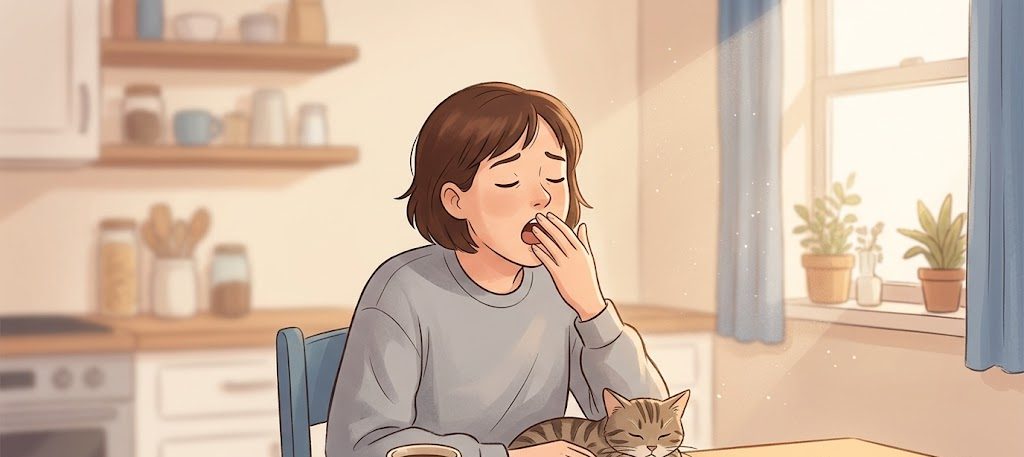
Sleepy vs. Tired: They Are Not the Same Thing
People use "tired," "fatigued," and "sleepy" interchangeably, but clinically they describe different things — and the distinction matters.
- Fatigue is a lack of energy or motivation. You could stay awake if you had to; you just feel drained. Fatigue is common in depression, anemia, thyroid disease, chronic illness, and long working hours.
- Sleepiness is the drive to actually fall asleep. If you sat in a quiet room with the lights dim, you would go to sleep — or you already have, repeatedly, without meaning to.
Pathological daytime sleepiness — the kind that signals a central disorder of hypersomnolence — is the second kind. It is a drive toward sleep that intrudes on alert situations and does not resolve after a full night's rest.
What Normal Daytime Alertness Looks Like
A reasonably rested adult should be able to:
- Sit through a movie, a meeting, or a long car ride without nodding off
- Drive safely without fighting to keep the eyes open
- Read for 20 to 30 minutes without falling asleep
- Feel reasonably alert within 15 to 30 minutes of waking (a mild morning "grogginess" is normal, but not hours of it)
- Notice a natural mid-afternoon dip, but not one severe enough to prevent functioning
A small afternoon dip around 1 to 3 p.m. is physiologic and normal. So is feeling sleepy when you're bored, in a warm room, or after a heavy meal. What is not normal is falling asleep in the middle of activities you want to be awake for.
Red Flags That Warrant Evaluation
Any one of the following is reason to talk to a clinician:
Sleep intrusions in active situations
- Falling asleep while driving, at red lights, or during commutes
- Falling asleep in meetings, conversations, or while eating
- "Microsleeps" where you lose a few seconds and don't remember them
- Needing multiple naps per day despite sleeping a full night
Sleepiness that sleep doesn't fix
- Sleeping 8 to 10 hours and still feeling profoundly sleepy the next day
- Waking up as tired as when you went to bed, for months on end
- Weekend recovery sleep never catches you up
Specific neurological symptoms
- Cataplexy — sudden, brief muscle weakness triggered by strong emotion (most classically laughter). The face sags, the jaw drops, the knees buckle. You are awake throughout. This is a specific symptom of narcolepsy type 1.
- Sleep paralysis — waking up (or falling asleep) unable to move for seconds to a couple of minutes
- Hypnagogic hallucinations — vivid, often frightening dream-like images or sounds as you drift off to sleep or wake up
- Severe sleep inertia — taking an hour or more to become functional after waking; feeling disoriented or almost drunk in the morning; struggling to wake up even with multiple alarms
Life impact
- Crashing or near-crashing a vehicle because of sleepiness
- Declining grades or job performance
- Missing social events because you had to sleep
- Depression or anxiety tied to chronic exhaustion
A Self-Screening Tool: The Epworth Sleepiness Scale
The Epworth Sleepiness Scale (ESS) is the most widely used brief questionnaire for daytime sleepiness. Rate your likelihood of dozing in each of the following situations over recent weeks:
- 0 = would never doze
- 1 = slight chance
- 2 = moderate chance
- 3 = high chance
- Sitting and reading
- Watching TV
- Sitting inactive in a public place (e.g., theater, meeting)
- As a passenger in a car for an hour without a break
- Lying down to rest in the afternoon when circumstances permit
- Sitting and talking to someone
- Sitting quietly after lunch without alcohol
- In a car, while stopped for a few minutes in traffic
Total score interpretation:
- 0–7: Unlikely to be abnormally sleepy
- 8–9: Average amount of daytime sleepiness
- 10–15: Excessive daytime sleepiness; consider medical evaluation
- 16–24: Severe excessive sleepiness; see a sleep specialist
The ESS measures the subjective propensity to doze, not objective sleep drive. A low score does not rule out a hypersomnia — some patients underreport their sleepiness because it has been their baseline for years. A high score is a strong signal to seek evaluation.
Common Causes to Rule Out First
Before labeling sleepiness as a central hypersomnia, clinicians work through more common causes:
- Insufficient sleep. The most common cause by far. Most adults need 7 to 9 hours; chronically getting 5 to 6 is not normal and not "just how I am."
- Obstructive sleep apnea. Snoring, witnessed pauses in breathing, gasping awakenings, morning headaches, or hypertension should trigger a sleep study.
- Shift work or circadian misalignment. Working nights, social jet lag, or delayed sleep phase disorder can produce profound daytime sleepiness.
- Medications. Sedating antihistamines, opioids, benzodiazepines, some antidepressants, antipsychotics, anti-seizure drugs, and muscle relaxants.
- Medical conditions. Hypothyroidism, anemia, iron deficiency, depression, chronic pain, heart failure, and others.
- Alcohol and cannabis use. Both disrupt sleep architecture even when they appear to help sleep.
Only once these are adequately excluded or treated is a central hypersomnia considered.
The Safety Issue: Drowsy Driving
This deserves its own section. Driving drowsy is not a minor infraction of willpower — it is, in measurable terms, comparable to driving drunk:
- Being awake for 17 hours straight produces impairment equivalent to a blood alcohol concentration of 0.05%.
- Being awake for 24 hours is roughly equivalent to 0.10%, which is above the legal limit in the US.
- Microsleeps of 3 to 5 seconds at highway speed cover the length of a football field.
If you are regularly fighting to stay awake behind the wheel, stop driving and get evaluated. Several US states have specific laws allowing charges for fatigue-related crashes.
When to See a Sleep Specialist
Make an appointment if any of the following are true:
- Your Epworth score is 10 or higher
- You have had any sleep-related driving incident or near miss
- You experience cataplexy, sleep paralysis, or sleep-related hallucinations
- You sleep 9+ hours per night and still feel profoundly sleepy
- Sleepiness is interfering with work, school, relationships, or safety
- You have been told you snore loudly, gasp, or stop breathing in sleep
- Your sleepiness has been building for months or years and has no obvious explanation
Ask your primary care provider for a referral to a board-certified sleep medicine physician. Bring a sleep diary covering at least 2 weeks and a list of all medications and supplements.
What Not to Do
- Don't self-medicate with large daily doses of caffeine or over-the-counter stimulants. They can mask symptoms without treating the cause and often worsen nighttime sleep.
- Don't assume it's depression and stop looking further. Depression and hypersomnia can look alike and can coexist; both deserve treatment.
- Don't accept years of being told you're "just tired." Unexplained, persistent sleepiness is a medical problem until proven otherwise.
Key Takeaways
- Sleepiness (falling asleep) and fatigue (low energy) are different symptoms with different causes.
- Pathological sleepiness intrudes on active situations and does not resolve with adequate sleep.
- Red flags include driving incidents, cataplexy, sleep paralysis, severe sleep inertia, and long sleep that isn't refreshing.
- The Epworth Sleepiness Scale is a useful self-screening tool — a score of 10 or higher warrants evaluation.
- Common causes (insufficient sleep, sleep apnea, medications, medical conditions) must be ruled out before diagnosing a central hypersomnia.
- If sleepiness is affecting your safety or functioning, ask your doctor for a referral to a board-certified sleep medicine specialist.