Augmentation: When Restless Legs Medicine Makes RLS Worse
Written and medically reviewed by Matthew Viereck, MD, board-certified sleep medicine physician · Reviewed October 2026 · Editorial standards
Chapters
- 0:00Disclaimer and who this video is for
- 0:17Three questions
- 0:37Restless legs and the dopamine medicines
- 1:10What augmentation is
- 1:40The signs of augmentation
- 2:22Why it happens
- 3:00How common it is
- 3:35Why the 2025 guideline changed
- 4:10Iron comes first
- 4:58The preferred medicines
- 5:33The most important message
- 6:02What the switch looks like
- 6:45If you are doing well
- 7:00Three things to remember
- 7:25Close
About this video
If you take pramipexole (Mirapex), ropinirole (Requip), the rotigotine patch (Neupro) or levodopa for restless legs syndrome, and your legs have slowly been getting worse instead of better, this video explains why. Augmentation is a medication-driven worsening of RLS: symptoms start earlier in the day, spread to the arms, come on faster at rest, feel stronger, and each dose wears off sooner.
We cover what augmentation is, why it happens with dopamine medicines, how common it is (about 7 percent of pramipexole users per year in a ten year follow up), why the 2025 American Academy of Sleep Medicine guideline moved away from dopamine agonists and levodopa as standard treatment, the role of iron (ferritin and transferrin saturation targets), the alpha-2-delta ligands that are now preferred, and what a safe switch looks like.
The most important message: do not stop or change your medicine on your own. Stopping a dopamine medicine suddenly causes a sharp rebound. Augmentation is managed with your clinician, usually by a slow, supervised switch.
Transcript
Show
0:00Disclaimer and who this video is for
This video is for educational purposes only and is not medical advice. Please talk with your own clinician before starting, stopping or changing any medicine. If you take a medicine for restless legs, and your legs have slowly been getting worse instead of better, this video is for you.
0:17Three questions
We are going to cover three things. What augmentation is. Why it happens with certain restless legs medicines. And what to do about it. One message will come up more than once, because it matters more than anything else here: do not stop or change your medicine on your own. Augmentation is managed together with your clinician.
0:37Restless legs and the dopamine medicines
Restless legs syndrome is an urge to move the legs, often with an uncomfortable feeling, that gets worse when you rest and worse in the evening. For about twenty years, the usual first treatment was a dopamine medicine. Dopamine is a brain chemical involved in movement. The common ones are pramipexole, sold as Mirapex; ropinirole, sold as Requip; the rotigotine patch, sold as Neupro; and levodopa, the older Parkinson's medicine. These medicines work very well at first. The problem shows up later.
1:10What augmentation is
Augmentation means the medicine itself is making the restless legs worse over time. Not the disease getting worse on its own. The medicine. It was formally defined by an international expert group in 2007, and the clearest sign is timing. Symptoms that used to start at ten at night begin to show up at eight, then at six, then in the afternoon. In the official definition, a shift of about four hours earlier in the day is enough on its own to diagnose augmentation.
1:40The signs of augmentation
There are other signs. The feeling spreads from the legs to the arms, or sometimes the trunk. Symptoms come on faster when you sit down, within minutes instead of an hour. The urge to move feels stronger. And each dose wears off sooner, so people start taking it earlier, or asking for a higher dose. That last part is the trap. Raising the dose brings relief for a while, and then the augmentation gets worse. If a higher dose seems to make things worse rather than better, that paradox is itself a sign of augmentation. So the takeaway for this section: earlier, spreading, faster, stronger, shorter relief. Those five words are augmentation.
2:22Why it happens
Why does this happen? We do not have the complete answer. The leading explanation is that constant stimulation of the dopamine system causes it to adapt against the medicine, so that over time the nervous system becomes more sensitive to restless legs than it was before treatment. Iron is part of the story. Iron is needed to make dopamine, and low iron stores are at the center of restless legs. In a large trial analysis, people who developed augmentation had lower ferritin, the blood marker of iron stores, than people who did not. Low iron and a dopamine medicine together are the combination we most want to avoid.
3:00How common it is
How common is it? In a ten year follow up at a specialist clinic, about seven percent of people taking pramipexole developed augmentation each year, and that rate stayed steady for up to ten years. Seven percent a year does not sound like much, but it adds up, year after year, for a medicine people take for decades. Levodopa is worse. In a six month European study, sixty percent of people taking levodopa daily developed augmentation. The takeaway: augmentation is not rare, and the longer you take these medicines, the more likely it becomes.
3:35Why the 2025 guideline changed
This is why the guidelines changed. In 2025, the American Academy of Sleep Medicine published a new treatment guideline for restless legs. It suggests against the standard use of dopamine agonists and levodopa. That is a reversal. For years these were the first choice. Now they are a fallback, for people who cannot take the preferred medicines or do not respond to them, at the lowest dose that works, with regular checks for augmentation. If you were started on one years ago, that was the standard of care at the time. Medicine updated itself. That is how it is supposed to work.
4:10Iron comes first
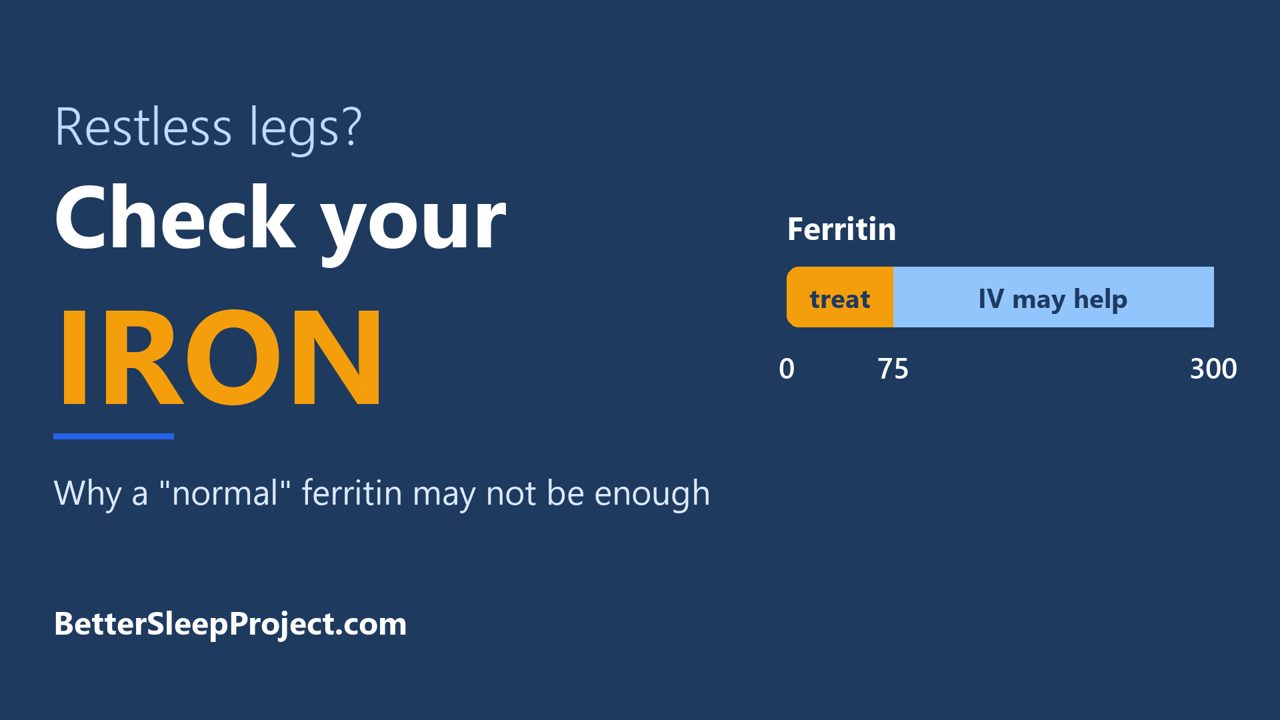
So what does the guideline recommend instead? Iron comes first. Everyone with restless legs should have iron studies: ferritin, and transferrin saturation, which is the share of the iron carrying protein that is actually carrying iron. The guideline says to treat with iron when ferritin is at or below seventy five, or transferrin saturation is below twenty percent. Notice that seventy five is well above the usual lab cutoff for normal. A ferritin of forty may be normal for the general population and still too low for restless legs. Iron can be given by mouth or by infusion, and the guideline gives a strong recommendation to intravenous ferric carboxymaltose for the right patients. There are additional, more nuanced guidelines for iron treatment in restless legs, so the details are a decision for you and your clinician.
4:58The preferred medicines
When medicine is needed, the preferred group is the alpha-2-delta ligands. That is the technical name for gabapentin, gabapentin enacarbil, sold as Horizant, and pregabalin, sold as Lyrica. All three carry a strong recommendation. In a one year head to head trial, augmentation occurred in about two percent of people on pregabalin, compared with nearly eight percent on the higher dose of pramipexole. These medicines have their own side effects, mostly sleepiness, dizziness and weight gain, so the choice is individual. But they carry much less risk of augmentation.
5:33The most important message
Now the message that matters most. If any of this sounds like you, do not stop your medicine on your own, and do not raise the dose on your own. Stopping a dopamine medicine suddenly causes a sharp rebound. Symptoms can come back harder than before treatment for days to weeks. That is not a reason to stay on it forever. It is a reason to make the change with a plan, and with your clinician. Augmentation is managed with a slow, supervised switch.
6:02What the switch looks like
What does that switch look like? Expert groups describe the same steps. First, check iron and treat it if it is low. Second, remove things that aggravate restless legs: sedating antihistamines like diphenhydramine, which is in most over the counter sleep aids, some antidepressants, alcohol, and untreated sleep apnea. Third, start an alpha-2-delta ligand and give it time to reach a dose that works. Fourth, taper the dopamine medicine slowly, often over weeks to months, expecting a rough patch along the way. In severe cases that do not respond, a specialist may use a low dose opioid under close supervision. Most people come out the other side with better control than they had on an ever rising dose.
6:45If you are doing well
One more thing. If you are doing well on a low, steady dose, with none of the warning signs, this is not an emergency. It is a conversation for your next visit: whether the plan still makes sense, and whether your iron has been checked recently.
7:00Three things to remember
Three things to remember. Augmentation is the medicine making restless legs worse: earlier in the day, spreading to the arms, faster at rest, stronger, with shorter relief. Current guidelines put iron first and the alpha-2-delta ligands ahead of dopamine medicines. And never stop or change the medicine alone. Bring the warning signs to your clinician and make the switch together, slowly.
7:25Close
This video is for education and is not medical advice. Talk with your own clinician about your treatment. The full article, with every reference, is at bettersleepproject.com. Thank you for watching.
References
- Winkelman JW, et al. Treatment of restless legs syndrome and periodic limb movement disorder: an American Academy of Sleep Medicine clinical practice guideline. J Clin Sleep Med. 2025;21(1):137-152.
- Garcia-Borreguero D, et al. Diagnostic standards for dopaminergic augmentation of restless legs syndrome: report from a World Association of Sleep Medicine-IRLSSG consensus conference at the Max Planck Institute. Sleep Med. 2007;8(5):520-530.
- Silver N, Allen RP, Senerth J, Earley CJ. A 10-year, longitudinal assessment of dopamine agonists and methadone in the treatment of restless legs syndrome. Sleep Med. 2011;12(5):440-444.
- Högl B, et al. Progressive development of augmentation during long-term treatment with levodopa in restless legs syndrome: results of a prospective multi-center study. J Neurol. 2010;257(2):230-237.
- Trenkwalder C, Högl B, Benes H, Kohnen R. Augmentation in restless legs syndrome is associated with low ferritin. Sleep Med. 2008;9(5):572-574.
- Trenkwalder C, Paulus W. Restless legs syndrome: pathophysiology, clinical presentation and management. Nat Rev Neurol. 2010;6(6):337-346.
- Allen RP, et al. Comparison of pregabalin with pramipexole for restless legs syndrome. N Engl J Med. 2014;370(7):621-631.
- Garcia-Borreguero D, et al. Guidelines for the first-line treatment of restless legs syndrome/Willis-Ekbom disease, prevention and treatment of dopaminergic augmentation: a combined task force of the IRLSSG, EURLSSG, and the RLS-foundation. Sleep Med. 2016;21:1-11.
- Silber MH, et al. An Updated Algorithm for the Management of Restless Legs Syndrome. Mayo Clin Proc. 2026;101(9):1561-1588.
More videos
Watch on YouTube or see every video on the Better Sleep Project channel.
Medical Disclaimer: This video is based on published sleep research and is provided for general education. It is not medical advice. Talk with your own clinician before starting, stopping or changing any treatment. Read full disclaimer.