What Is a Home Sleep Apnea Test?
A home sleep apnea test, sometimes called an HSAT or a home sleep study, checks for sleep apnea while you sleep in your own bed. Instead of a night in a sleep lab with sensors on your scalp, face and legs, you wear a small device for one night that records your breathing and your oxygen.
It is simpler and often more convenient than a lab study. But it measures less, and that matters for what the result means. A home test is very good at confirming sleep apnea in the right person. It is less good at ruling it out.
Watch it: our five minute video Home Sleep Apnea Test: How It Works and What It Misses shows each part of the test, the setup, and why it can make sleep apnea look milder than it is.
See the lab night: if your doctor ordered a study in a sleep lab instead, our video What to Expect at an Overnight Sleep Study walks through the night, and Understanding Your Sleep Study explains the results.
Who a Home Test Is For
A home test is meant to answer one question: does this adult have obstructive sleep apnea, the common kind, where the throat closes off during sleep? The American Academy of Sleep Medicine (AASM) recommends either a home test or a lab study for adults whose symptoms point to moderate or severe sleep apnea and who have no other major health problems.
A study in a sleep lab is the better choice for people with:
- Significant heart or lung disease
- A nerve or muscle condition that weakens breathing
- Breathing that is too shallow during the day or suspected to be too shallow at night
- Chronic use of opioid medicines
- A past stroke
- Severe insomnia
A lab study is also the test for most sleep problems other than sleep apnea, such as narcolepsy, periodic limb movements, or unusual behaviors during sleep.
What It Measures, and What It Doesn't
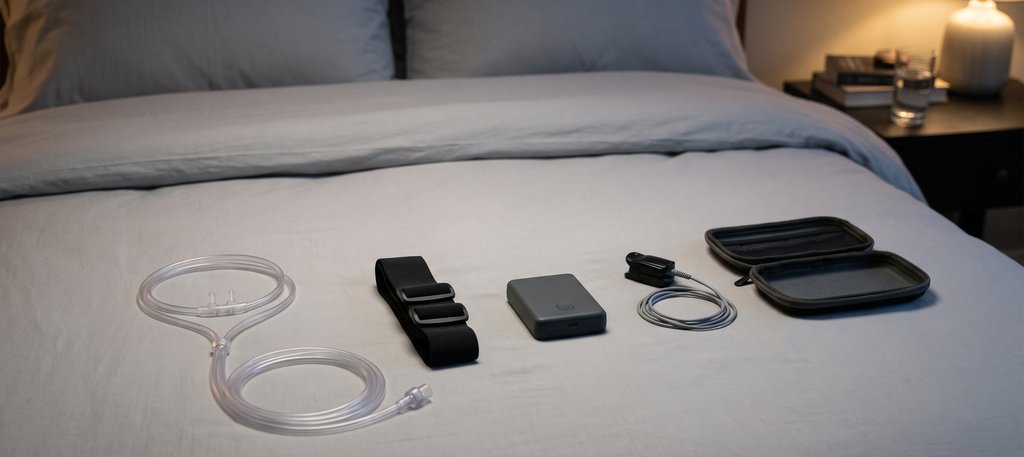
Most home tests have three parts:
- A thin tube at the nose, called a nasal cannula, with two short prongs that sit just inside the nostrils. It measures airflow.
- A soft belt around the chest, which measures breathing effort.
- A clip on a finger, which measures oxygen and pulse.
Some devices also record your sleep position or snoring.
What a home test does not have is brain wave sensors. In a sleep lab, small sensors on the scalp show when you fall asleep, which stage of sleep you are in, and every brief waking. Without them, a home test can see your breathing, but it cannot tell whether you are asleep or lying awake. That one difference explains most of what a home test can miss.
Setting It Up for a Good Result
A good result starts with the setup. Your sleep clinic or the company that supplies the device will give you instructions, and those come first. In general:
- Practice before bedtime. Read the instructions and try everything on early in the evening, not in the dark.
- Place the nasal tube. The prongs go just inside the nostrils, and the tubing loops over your ears and under your chin.
- Fasten the belt. It should be snug around your chest, not tight.
- Put on the finger clip. Use a finger with no nail polish or artificial nail, which can block the reading.
- Start the device the way your instructions say.
- Go to bed at your usual time and sleep in your usual position.
Take your usual medicines unless you were told otherwise, and skip alcohol that evening. If you wake up in the night and something has come off, put it back on. Then return the device the way your instructions say, usually the next day.
What Can Go Wrong
Home tests do fail. The most common problems are sensors that come loose, a finger clip that slips off, or a signal too poor to read. In one study cited by the AASM guideline, about 82 of every 100 first home tests were good enough to read, which means almost 1 in 5 were not.
Two other limits come from what the device can and cannot see:
- Telling the two kinds of sleep apnea apart. In obstructive sleep apnea, the throat closes even though the body keeps trying to breathe. In central sleep apnea, the brain briefly stops sending the signal to breathe. A home test can have trouble telling these apart, and they are treated differently.
- A bad night is hard to see. Because the test cannot measure sleep, a night spent mostly awake can look like a night of sleep on the recording.
Why It Can Make Sleep Apnea Look Milder
Sleep apnea is graded by how many breathing events happen per hour. A breathing event is a pause in breathing, called an apnea, or a stretch of shallow breathing, called a hypopnea. Fewer than 5 an hour is considered normal.
A lab study divides the number of events by the hours you were actually asleep. A home test cannot see sleep, so it divides by the hours it recorded instead. On a home test report, this number is often called the respiratory event index, or REI, rather than the apnea hypopnea index (AHI).
Here is what that difference does. Say the device records for 8 hours and counts 32 breathing events. That is 4 an hour, which looks normal. But if you slept badly and were only asleep for 4 of those 8 hours, the real number was 8 an hour, which is sleep apnea.
There is a second reason the number runs low. Some hypopneas end in a brief waking from sleep rather than a drop in oxygen. A lab study counts those, because the brain wave sensors show the waking. A home test cannot see them, so it misses them. Loose sensors and a poor signal add further error. The AASM guideline names all of these as reasons a home test can underestimate the true number.
When the Test Is Negative
A negative home test does not rule out sleep apnea, and milder sleep apnea is the kind most likely to be missed, because an undercount is enough to drop it below the cutoff. In the studies behind an earlier AASM guideline, home tests missed sleep apnea as often as 17 times in every 100.
That is why the current guideline is clear. If a home test is negative, unclear, or failed, and sleep apnea is still suspected, the next step is a study in a sleep lab, not a second home test. A second home test is more likely to be negative, unclear, or failed again, and people are more likely to drop out before they get an answer.
If you are still very sleepy despite a negative home test, it is also worth asking whether something else is going on. Sleepiness has other causes, such as narcolepsy and idiopathic hypersomnia. When those are a concern, a daytime nap study, called a multiple sleep latency test, may be added the day after a lab night. For more, see Is This Sleepiness Normal?
The short version: a negative home test is not the end of the road if you still do not feel right. Tell the clinician who ordered it.
Your Results
A sleep clinician reviews the whole recording, not just the number the device prints. You then go over the results at a follow up visit. If the test shows sleep apnea, that visit is where treatment starts. Most people with moderate or severe sleep apnea start with CPAP, which stands for continuous positive airway pressure; our CPAP setup guide covers the first two weeks. Some people whose sleep apnea happens mainly on their back may do well with positional therapy.
For what the numbers on a sleep study report mean, including the severity ranges, see Understanding Your Sleep Study.
Key Takeaways
- A home sleep apnea test records breathing and oxygen in your own bed, but it has no brain wave sensors, so it cannot tell when you are asleep
- It is meant for adults whose symptoms point to moderate or severe sleep apnea and who have no other major health problems
- Practice the setup before bedtime, keep the sensors snug, and put back anything that comes off
- Because it divides by hours recorded rather than hours asleep, and misses events that end in a brief waking, it can make sleep apnea look milder than it is
- A negative home test does not rule out sleep apnea; if it is still suspected, the next step is a lab study, not a second home test